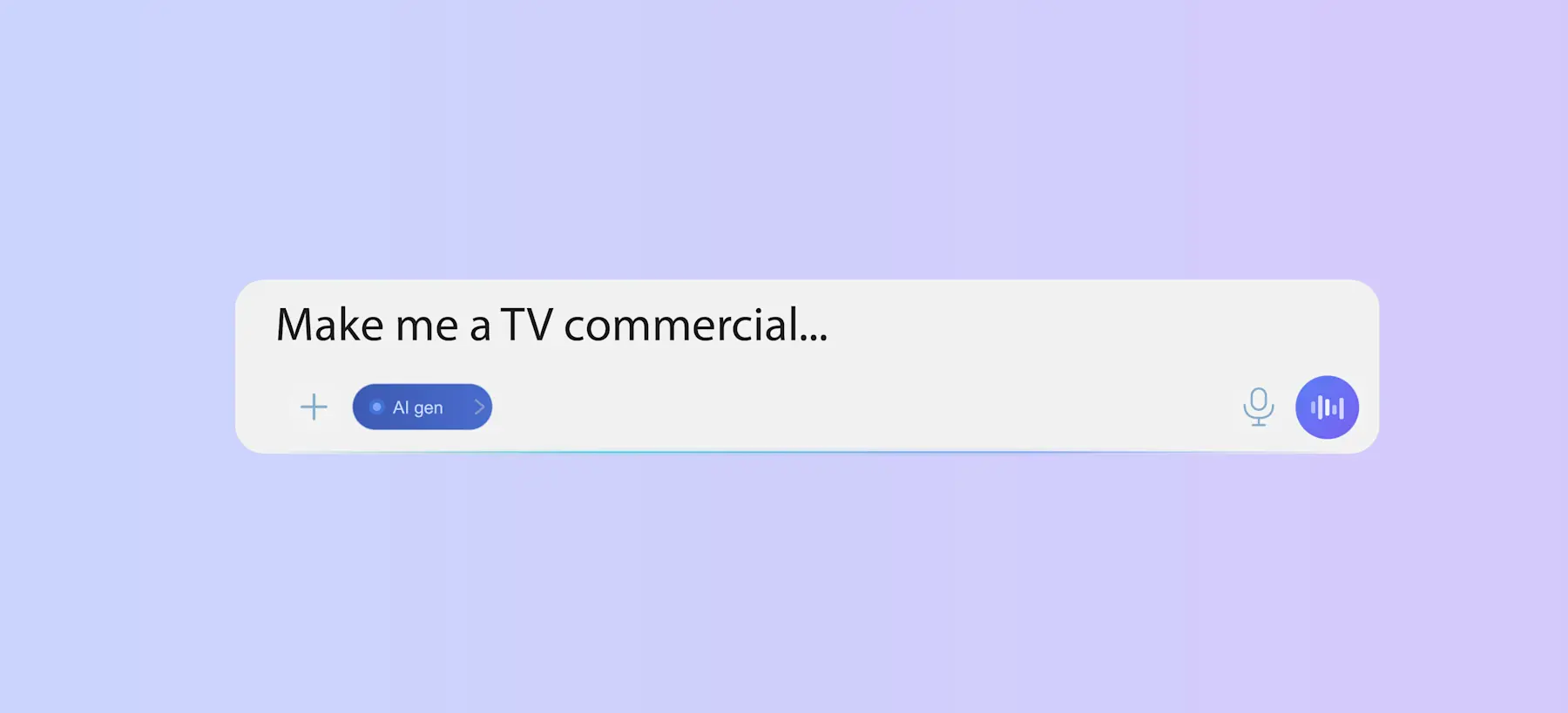
How Advertisers Use AI to Create TV Spots
AI is rewriting the rules of advertising. From media planning to media buying, the industry is moving fast to adopt AI-led strategies. But perhaps the most transformative shift is happening on the creative side. Specifically, how brands are using AI to produce TV commercials.
The hyperbole in the headlines could lead you to believe that creating an effective TV commercial with AI is as simple as typing a prompt, pressing a button, and voila - Clio-award winning creative! Not so fast. The reality is more nuanced. AI tools have advanced rapidly, but few of them are complete end-to-end creative solutions. In practice, producing a polished TV spot with AI still means stitching together multiple tools - one for storyboarding, another for animation, another for voiceover — and then doing significant manual editing to bring it all into a cohesive final cut. Not to mention the creative fundamentals that haven't changed at all: strategic messaging, strong storytelling, and the critical thinking needed to understand what actually resonates with an audience. AI can generate endless possibilities at speed. But marketers still have to guide the process, make the decisions, and do the work of assembling the pieces.
The brands seeing the most success with AI aren't replacing their creative workflows. They're using AI as an accelerator; a support tool to help them move faster, test more, and bring campaigns to market more efficiently.
How Tatari Clients Are Experimenting With AI Creative
We spoke with clients across different industries who are incorporating AI into different stages of the creative process. Some use it to generate early concepts and scripts. Others rely on it to transform existing content into TV-ready ads or quickly produce multiple creative variations. Here's what they told us.
BAERSkin: From 8-Second Clips to 30-Second Stories
BAERSkin’s AI creative journey is a testament to how fast AI is moving. When Google released Veo 3 around October 2025, the manufacturer of the #1 Outdoor Waterproof Tactical Hoodie began experimenting with AI-generated video, starting with short 8-second clips. By early 2026, they were producing fully animated 30-second spots. That's a meaningful creative leap in a very short window.
Their process starts the same way it always has. The team writes scripts, brainstorms, and builds storyboards. What's different is what happens once the storyboard is locked. "Instead of turning to cameras, we turn to AI,” said BAERSkin’s Head of Marketing, Luke de Kock. “Suddenly we can create scenes, characters, locations, and scenarios that would be completely out of reach for our production team's budget and scale. Fantastical characters. Impossible locations. Props that don't exist. Environments we could never access. AI has unlocked a creative ceiling that traditional production kept firmly in place."
Their current stack reflects the multi-tool reality of AI creative production: Google Nanobanana for storyboard creation and product integration, Miro for storyboard review and team approvals, Google Veo 3 to animate storyboard frames into video sequences, ElevenLabs for voiceover generation, and ChatGPT and Claude for scriptwriting support — all brought together with traditional video editing to produce the final cut.
"AI is iterative. Not every output is usable. But the more you work with it, the more gems you find. It rewards persistence and volume."
The results have been strongest in the 30-second format. While BAERSkin still produces longer-form YouTube content using traditional production, AI has allowed them to crack the 30-second spot far more efficiently, enabling the kind of visually ambitious content that once would have demanded a budget most DTC brands couldn't justify.
“On average, we can go from script to a finished 30-second spot significantly faster than traditional production.”
Levels Protein: Elevating Creative Possibilities
Levels approached their foundational TV spot with a creative vision that felt out of reach; the kind of concept where traditional production would either demand a massive budget or force a creative compromise. They chose neither.
"When we first conceived the idea for this hero spot, we assumed there were no real-world production techniques that could pull off what we were imagining without spending a fortune," said Founder and CEO of the premium protein brand, Blake Niemann.
"In some ways, what we built here would not have been possible even a few years ago. But instead of backing off, we leaned in. We pushed the boundaries of how AI can expand the creative process without replacing it. Used correctly, these tools don't dilute creativity. They unlock it. They open doors to visual languages that simply didn't exist before."
For brands that have ever shelved a creative idea because the production cost made it impossible, that's the real promise of AI. Not just faster, but bolder.
Why AI Is Gaining Momentum in Creative Production
As the experiences of brands like BAERSkin and Levels illustrate, there are several compelling reasons why marketers are increasingly experimenting with AI-driven creative.
Speed
Traditional commercial production can take weeks or months, from scripting to filming to editing. AI tools allow teams to generate concepts and animated sequences much faster, dramatically compressing production timelines. What once took months can now take days — though the iterative, multi-tool nature of current AI workflows means "instant" is still a stretch.
Cost Efficiency
Producing high-quality video creative historically required significant investment in production crews, filming locations, and editing resources. AI-driven workflows can help reduce some of those costs while still enabling brands to produce compelling creative, particularly for 15- and 30-second TV spots, where the production-to-airtime ratio makes cost efficiency especially valuable.
Repurposing Existing Creative
AI tools can transform social posts, product pages, or existing assets into TV-ready ads, allowing brands to build on content they already have rather than starting from scratch. This is particularly relevant for performance-driven DTC brands already producing a high volume of social content.
More Experimentation, at Scale
Because AI reduces production time and cost, brands can experiment with more creative concepts, but the more significant benefit may be what comes after that. Traditionally, TV has been a "paint with a broad brush" medium: you produce one spot, and it reaches everyone. AI changes that equation. Brands can now create a single core concept and generate 10, 50, or even 100’s of variations of the same ad. Before, each of those would have required a full reshoot and edit. With AI, the same variation might take an hour. This kind of hyper-targeted creative personalization at scale is genuinely new, and it's one of the more underappreciated implications of where this technology is heading.
Don’t Believe (All) the Hype
As Public Enemy once said, don't believe the hype. Despite the excitement around AI, the idea that brands can simply type a prompt and instantly generate a winning commercial is far from reality, as evident by what our own clients have shared.
Producing strong creative still requires:
Strategic messaging
Creative direction
Iteration and refinement
Understanding what resonates with audiences
There's also the question of audience perception. Consumer research suggests many viewers remain skeptical about AI-generated advertising, with more than 30% of consumers across every age group saying AI-generated ads make them less likely to choose a brand. Audiences still expect advertising to feel authentic and emotionally resonant. When brands lean too heavily on automation without creative oversight, the results can fall flat. Even major brands have learned this lesson when experimenting with fully AI-generated campaigns that failed to connect.
That instinct is reflected in Tatari client data: 86% of brands say they will not use AI to create 100% of their TV ads, and only 2% are ready to fully commit to that approach. Most marketers see AI as a way to support and accelerate the creative process. The most common expected uses are automating production tasks and speeding up creative workflows (46%), followed by evaluating and guiding creative decisions (32%). Advertisers view AI less as a replacement for creative teams and more as a powerful co-pilot.
The Growing Ecosystem Supporting AI Creative
For many brands, the challenge isn’t whether to explore AI in creative production, it’s how to do it effectively. The tools in this space are powerful, but they still require the right creative expertise and production workflows to deliver results that meet TV quality standards. A growing ecosystem of platforms, production partners, and creative specialists has emerged to help brands navigate this.
Tatari works with a curated group of partners that help brands explore AI-powered creative development, UGC production, and traditional creative services depending on their needs.
Partner | Category | Best For... |
Waymark | AI SaaS | Turn a business URL or existing assets into broadcast-ready video ads in minutes. |
SpaceBack | AI SaaS | Convert high-performing social posts into 4K CTV-ready ads, metadata and all. |
AdGreetz | AI SaaS | Orchestrate 56+ AI models to produce and deploy hyper-personalized ads at scale across 24 channels. |
Creatify | AI SaaS | Turn any product URL into multiple video ad variations for rapid creative testing. |
Screenbridge | Premium UGC | Elevates creator and UGC footage into broadcast-quality TV and CTV ads with fast turnaround. |
Cinebody | Hybrid UGC | Hybrid UGC Patented platform that captures professional-quality footage from real customers and communities, deployable across social, CTV, and broadcast. |
Our goal is to help brands experiment with new creative approaches while maintaining the quality and performance standards required for TV advertising.
Where AI Fits Into the Future of TV Advertising
AI is unlikely to replace creative teams anytime soon. But it is reshaping how ads are produced. The most successful brands are treating AI as a tool that enhances human expertise rather than replacing it. By accelerating production timelines, enabling more experimentation, and lowering creative barriers, AI is giving marketers the ability to move faster than ever before. At the same time, the fundamentals of great advertising haven’t changed. Strong storytelling, emotional connection, and creative insight are still what make ads memorable. AI may help brands produce more ads, but it’s still up to marketers to ensure that creative actually works.

Sam Joachim
I lead client services at Tatari. Outside of work, I have a passion for entertainment, music, and creative pursuits — having supported world-renowned recording artists and produced TV ads that aired during the Super Bowl.
Related
UPDATED: How to Budget and Plan for TV in 2026
TV continues to grow as a viable channel for advertisers, earning a larger role in how brands plan, scale, and measure their media investments. This guide breaks down the key TV trends shaping 2026, including a quarter-by-quarter look at the biggest events influencing budget decisions.
Read more

Avocado Mattress Proves Interactive CTV Ads are Ripe for Growth
Avocado Mattress cracked the code on streaming by turning passive viewers into active shoppers through interactive CTV ads that helped drive retail foot traffic. Explore how these emerging ad formats are finally transforming the big screen into a powerful, actionable storefront.
Read more

How to Build a World Class Marketing Team | Vineet Mehra
What does a high-performing marketing org actually look like in 2026—when AI, growth pressure, and brand all collide? Chime Chief Growth and Marketing Officer, Vineet Mehra, cuts through the noise with a sharp, experience-backed framework for building teams that scale efficiently and avoid the silos holding most marketers back.
Read more