2026 Super Bowl Ads That Drove the Most Engagement
An Objective Performance Analysis of this Year’s Super Bowl Ads
The Super Bowl is TV's biggest advertising event of the year, delivering unmatched scale and one of the most engaged audiences in media. According to NBC, 124.9 million viewers watched this year's game, making it the second most-watched show in US history and peaking at 137.8 million in the second quarter, giving the 64 brands who ran spots in this year’s game a rare opportunity to reach a record number of viewers in the same cultural moment.
But which ads actually drove engagement?
As a whirlwind of opinions and hot takes swept through social media, we took a different approach: grounding our rankings in objective, quantitative performance signals rather than subjective reactions. Instead of relying on creative sentiment, brand recall surveys, or anecdotal feedback, we analyzed real behavioral data to identify which advertisers generated meaningful consumer engagement.
Engagement is tricky to measure as it can encompass everything from online searches and social media conversation to website visits and app installs. Without access to every brand's internal data, some of these signals are out of reach. So we focused on the metric most readily available and most revealing: incremental search lift.
Following the Super Bowl, we analyzed the incremental search lift for every ad spot aired during the broadcast, as well as during pregame and post-game coverage. While some industry analysis rely on an automated process for evaluating search trends by keyword, our approach carefully incorporates the appropriate keywords, misspellings of keywords, and related keywords that take users to the same brand. We believe this provides a complete and accurate picture of performance.
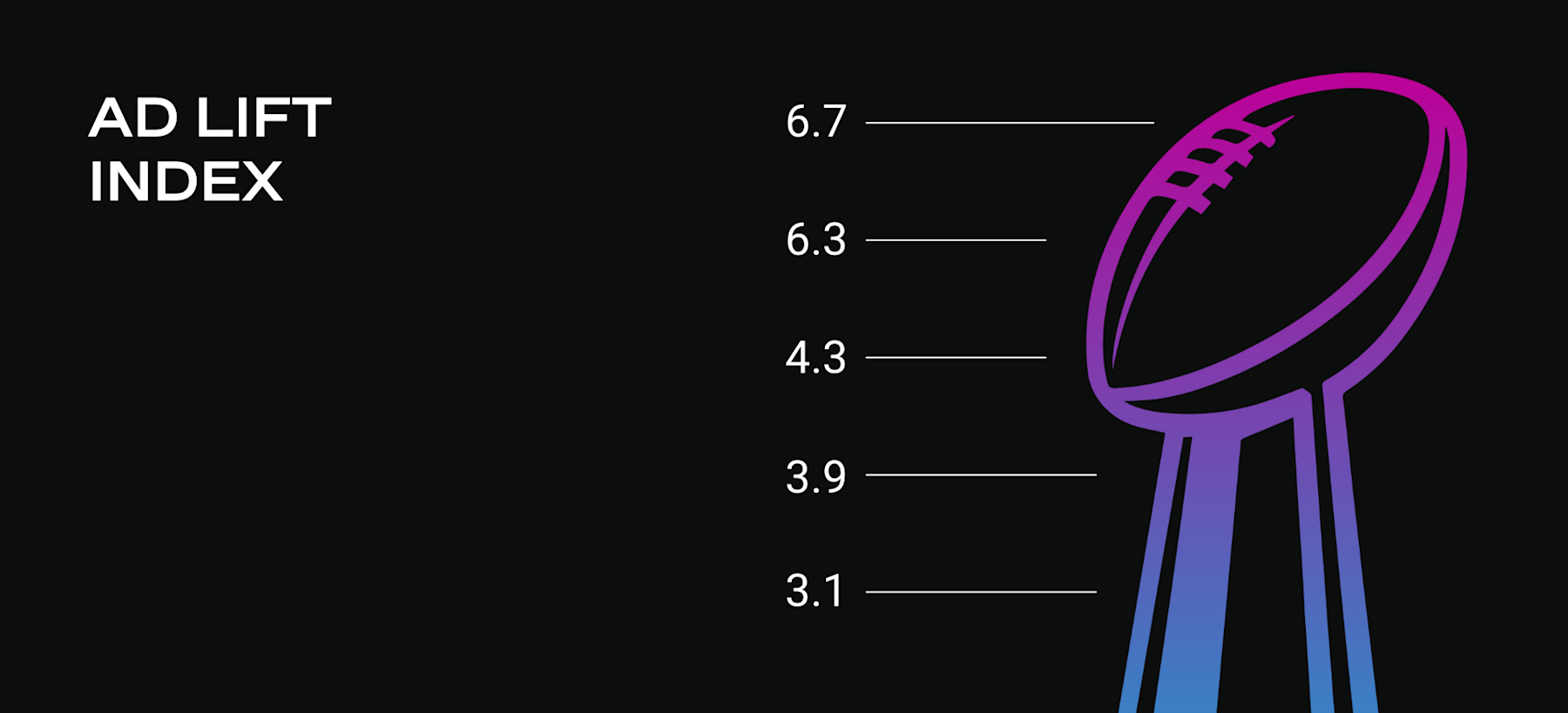
Search lift is a powerful indicator of real consumer interest, capturing immediate intent rather than subjective recall. All ads were indexed against the median lift value of in-game ads to enable direct comparison, so a lift index of 2.0 means a brand's ad generated twice the median Super Bowl ad's immediate lift in Google search volume, where "immediate lift" is defined as the incremental gain in search volume over a five-minute window following the ad. Using a combination of observed lift values and Tatari's proprietary performance evaluation methods to compute search baselines and normalize across all brands, we created the Super Bowl Advertiser Scorecard to rank the strongest-performing ad spots of the night.
Let's peel back the numbers and take a play-by-play look at the biggest advertising winners from this year's game.
The Top Performers
To evaluate Super Bowl ad performance, we tracked search behavior in the minutes and hours following each spot’s airtime, capturing both the immediacy and durability of audience response. We measured total impact by calculating the area under each ad’s search-lift curve and converting it into the lift index described earlier, allowing for a ranked comparison across all advertisers. Using this approach, the top-performing ad we tracked this year was the trailer for Universal Pictures’ Minions & Monsters, which generated a sharp, immediate surge in search interest—one of the clearest signals of real-time engagement and intent. Below is the full list of the Top 10 Super Bowl ads based on lift index performance.
Advertiser | Timing | Lift Index | Category |
Q2 | 7.60 | Entertainment & Streaming | |
Q4 | 6.31 | AI | |
Q4 | 6.08 | Technology | |
Q2 | 4.30 | Entertainment & Streaming | |
Halftime | 4.15 | Sports | |
Q3 | 4.03 | Technology | |
Q3 | 4.01 | Beer & Spirits | |
Q4 | 3.92 | Food & Snacks | |
Pre-game | 3.87 | Entertainment & Streaming | |
Q1 | 3.63 | AI |
Top performers used innovative creative strategies that mixed call to action via QR codes to live integrations in the game. Lay’s featured a 72-hour guarantee from potato-to-door delivery for bags of chips requested via a QR code in the ad. Salesforce (Slack) garnered even higher levels of interest by bundling a QR code call to action with a $1M giveaway featuring MrBeast and Slack’s AI tools. On the other hand, Budweiser utilized a captivating transition as the creative, featuring a Clydesdale and Eagle, segued into a live integration from Levi’s Stadium, where the characters were present at the event.
Category Insights: What Drove the Biggest Spikes
As you’ll notice, Entertainment & Streaming, AI, and Technology dominated the top of the leaderboard this year, accounting for seven of the top ten ad spots. This concentration reflects a broader pattern: categories that naturally stimulate immediate curiosity, discovery, and information-seeking behavior tended to generate the strongest short-term search response this year.
Entertainment & Streaming led all categories at the very top of the rankings, driven primarily by major movie trailers and franchise-based promotions. These ads benefitted from a built-in advantage: viewers are often motivated to search for trailers, release dates, cast information, and plot details immediately after exposure. In this year’s game, theatrical releases and streaming properties accounted for three of the top ten spots, including the single highest-performing ad of the night.
AI and Technology advertisers also performed exceptionally well. These categories are fueled by novelty, fast-moving innovation cycles, and growing mainstream interest, which naturally translate into strong post-ad search behavior. In particular, AI-focused brands generated substantial curiosity-driven engagement, as viewers sought to better understand new tools, capabilities, and product positioning in a rapidly evolving category.
Sports and Live Events, represented here by the Olympics, showed strong performance as well. Major global events tend to trigger event-driven searches, as viewers look for schedules, athlete information, and broadcast details, especially when paired with high-visibility placements like halftime.
Meanwhile, traditional consumer categories such as Beer & Spirits and Food & Snacks delivered solid but more moderate lift. These categories typically face higher baseline awareness and lower information-seeking urgency, which can dampen immediate search response, even when creative quality is strong.
Does Timing Matter? Yes—But Not Alone
Timing | Median Lift Index |
Pre-Game | 0.31 |
Q1 | 1.06 |
Q2 | 1.29 |
Halftime | 0.65 |
Q3 | 1.53 |
Q4 | 1.82 |
Post-Game | 0.28 |
Third and fourth quarter ads clearly outperformed other periods. That said, timing alone doesn’t explain everything, and focusing on it in isolation can be misleading. Also note that there were not as many ads this year in the second half of the game as there were earlier in the game, and most of the fourth quarter ads were stacked toward the beginning of the quarter, when both teams scored their first touchdown of the game.
Industry Effects Are Hard to Ignore
One of the most striking findings from this analysis was how much performance varied by industry. When grouped by category, median lift differed dramatically:
Industry | Lift Index |
Entertainment & Streaming | 2.45 |
Weight Loss | 2.18 |
Technology | 2.06 |
AI | 1.86 |
Medical & Health | 1.58 |
Automotive | 1.57 |
Beer & Spirits | 1.51 |
Sports | 1.50 |
Travel & Hospitality | 1.43 |
Food & Snacks | 1.42 |
Drinks (Non-Alcohol) | 1.30 |
Restaurant & Delivery | 1.00 |
PSA | 0.83 |
Finance & Business Services | 0.68 |
Consumer Products | 0.49 |
Sports Betting | 0.36 |
Note: Scaled lift index per industry category is skewed high because the lift numbers are scaled to the median and the data distribution is right skewed.
These differences are substantial and reflect varying baseline levels of consumer interest. In many cases, industry effects can overwhelm other factors like timing or placement, making it essential to evaluate performance in context rather than drawing surface-level conclusions. But, a quick review of this data at the median level can still yield some valuable directional insight.
Industry performance helps contextualize why some categories popped so hard. Entertainment & Streaming often converts Super Bowl exposure into immediate “tell me more” behavior (trailers, release dates, cast), and this year that showed up with movie-heavy placements driving outsized lift. Sports Betting provides a useful contrast: the next step is frequently opening an app (or heading straight to the app store) rather than searching, so response can show up through a different pathway under a search-lift lens. Furthermore, online sportsbooks are not legal in every state. Weight loss placements also over-indexed, likely because GLP-1s have become a mainstream conversation and the category now includes genuinely new formats (including a highly anticipated daily oral option), which pushes viewers to actively research details in the moment. Technology/AI is benefiting from a similar curiosity tailwind. LLMs and AI tools are moving fast and reaching new audiences, so a high-profile spot often triggers immediate exploration to understand what a product actually does. Overall, these category trends surface a key strategy to build awareness: pairing engaging creatives with timely narratives that viewers are already primed to explore.
Do Multiple Ads Hurt—or Help?
Another common question: does airing multiple Super Bowl ads dilute impact?
Looking at aggregated performance across all advertisers, we found something unexpected. Among brands that aired multiple spots, including brands like Pepsi, Lays, and Budweiser, there was no evidence of meaningful performance drop-off when they aired a second or even third ad. In fact, we found that the second ad performed best on average. While the sample size limits definitive conclusions, the initial data does not show evidence of consumer fatigue associated with multiple brand appearances.
The Impact of Ad Position
We also examined ad performance by pod position, which refers to where an ad appears within a commercial break. A pod position of First indicates the first ad to air immediately after returning from programming, followed by Second. The Last is the last ad in the pod and the second last is the one prior to that. Everything else is bunched into Middle. The reason for this denotation is that ad breaks vary in the number of ads, and later positions are not always directly comparable, which can influence observed performance. Thus, this is our attempt to debias this somewhat.
Pod Position | Median Lift Index |
First | 1.02 |
Second | 0.83 |
Middle | 0.67 |
Second Last | 0.48 |
Last | 1.66 |
Overall, it appears that the bookends (first and last ads) generally performed better. Although, it is important to note that these results are descriptive rather than predictive.
What is Not Covered Here
Another key driver of performance is the quality and content of the creative itself. For this analysis, we are intentionally not evaluating creative content, as it warrants its own dedicated deep dive. The quality and content of the creative alone can account for a substantial share of the volatility in ad performance, and properly assessing its impact requires a more comprehensive framework than what is in scope here.
Additionally, this article does not focus on the longer-term effects of Super Bowl advertising. We plan to publish a more comprehensive review of these downstream impacts in the coming weeks, once sufficient time has passed for those effects to fully materialize in the data. In the meantime, for an insightful perspective on the nature of these longer-term dynamics, we recommend this excellent article on The Economics of a Super Bowl Ad, featuring one of the clients we helped air during the game, Ro.
The Bottom Line
The Super Bowl remains one of the most powerful stages in advertising, but performance is driven by far more than airtime alone. Industry dynamics, creative quality, placement positioning, and timing all play meaningful roles, and understanding how they interact is key to separating real impact from hype.
Objective measurement cuts through the noise, and the results may surprise you.

Brent White
I’m a Data Scientist at Tatari, where I dive into marketing mix models to help our clients scale. Outside of work, you’ll find me enduring a Chargers game, tinkering with my car, or strolling with my pup
Related
How Streaming Is Democratizing the Biggest Ad Stage in America
Streaming and precision targeting are making the Super Bowl accessible to brands of all sizes—reshaping a massive broadcast into a flexible, multi-screen opportunity.
Read more
Why Sports Is The Fastest Way To Break CTV’s Programmatic Ceiling
Programmatic buying dominates CTV, but it rarely delivers true scale. Here’s why sports-focused direct buying is the game plan brands are using to unlock reach, context, and measurable impact—without blowing budgets.
Read more
What Advertisers Need to Know About TV Sports Advertising in 2026
TV sports advertising in 2026 is being reshaped by streaming, fragmented media rights, and rapidly changing ad prices. This guide shows advertisers where sports audiences live and how to buy across leagues effectively at any budget.
Read more