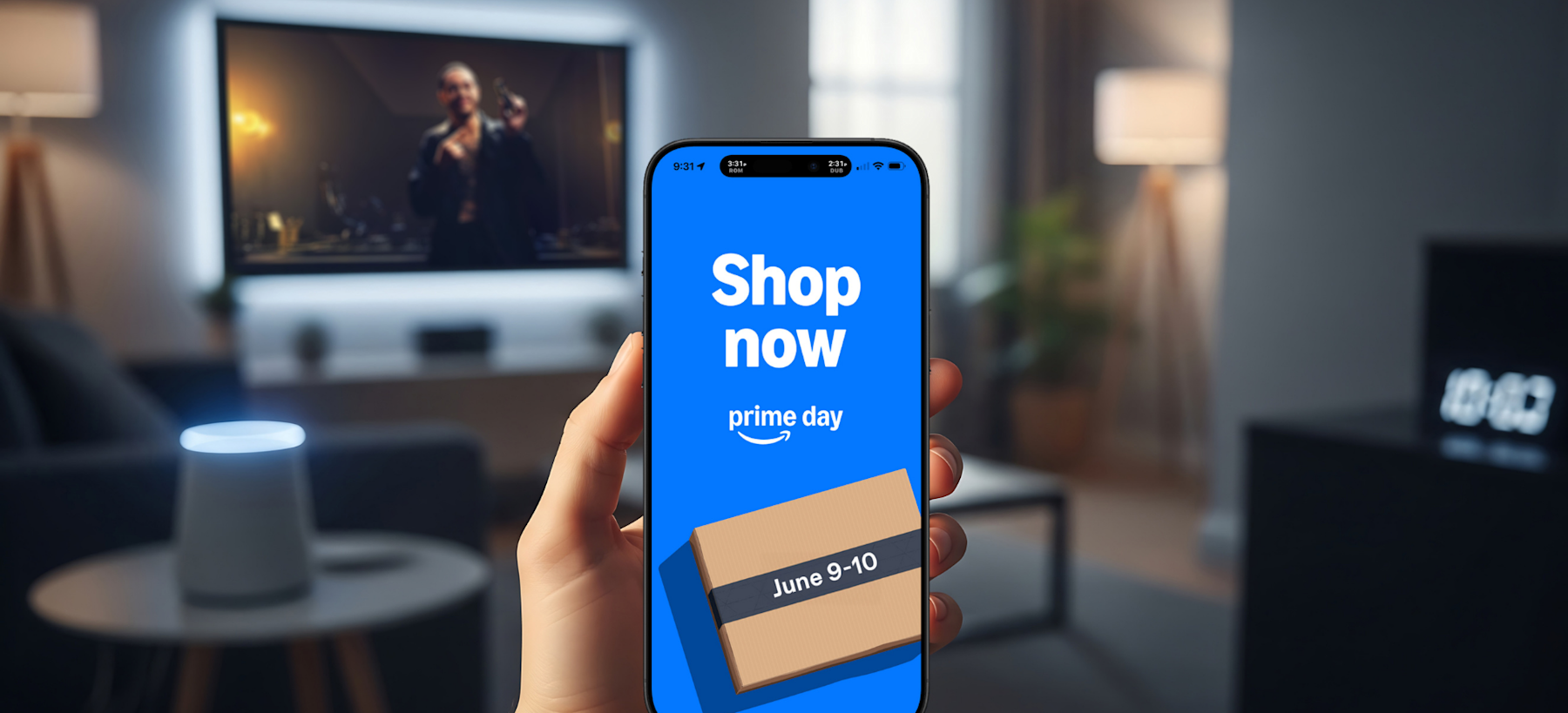
Why Amazon Prime Day is a Prime Opportunity for TV Advertisers
Another Prime Day is right around the corner. Amazon has officially moved its annual deals event to mid-June, breaking from its traditional July window. And based on last year's numbers, there’s tremendous opportunity for retailers. Last year's bi-annual shopping event drove an estimated $24.1 billion in U.S. online spending over four days, with Amazon's average daily order total running 136% higher during Prime Day than the year-to-date daily average. That kind of concentrated purchase intent creates something most media plans don't account for: a moment where the conversion environment is already working in your favor.
For brands that sell on Amazon, this matters more than it might seem.
The Number That Should Change How You Plan Prime Day
Tatari analyzed TV advertising performance for four brands with sufficient Amazon sales data around Prime Day. The result was consistent across all four brands. TV-attributed Amazon CPAs were 43% to 64% lower during Prime Day than in the immediate post-Prime Day period.
The takeaway? When shoppers were already on Amazon ready to buy, TV worked harder.
That's not a small efficiency difference. A CPA that drops by half, even for a two-to-four-day window, matters for any brand with substantial Amazon volume.
How We Measured It
Tatari defines Amazon CPA as a modeled estimate of the incremental cost of acquiring an Amazon order that can be attributed to a specific TV ad. It’s calculated using Tatari's proprietary Amazon sales lift analysis, which estimates expected Amazon orders, measures incremental lift around TV airings, and attributes that response back to individual spots using a time-response profile.
The comparison was made against the days immediately following Prime Day, not the days before it. Pre-event behavior is messy: some shoppers deliberately delay purchases waiting for Prime Day deals, I mean who wouldn’t want 30-40% off a cherry-shaped toilet brush? The post-event period provides a cleaner read on whether TV performed differently during the event window itself.
Prime Day Consistently Moved the Needle
Across the four advertisers we measured, Prime Day was consistently more efficient. Median modeled Amazon CPAs during Prime Day were 0.36x to 0.57x of post-Prime Day levels, meaning TV-attributed Amazon orders cost materially less during the event window than immediately after it.
The exact CPA levels varied by advertiser, which is expected. Categories, price points, Amazon maturity, and media plans all differ. The consistent direction is the more important finding.
Figure: Spot-level modeled Amazon CPA distributions for four anonymized advertisers, Prime Day vs. the immediate post-Prime Day period. Across the usable advertiser set, Prime Day CPAs shifted lower, indicating stronger Amazon efficiency during the event window.
The Real Story is About Attention
The obvious explanation is that TV simply got more attention during Prime Day. The data suggests a more nuanced story.
Company-site response - Tatari's proxy for TV-generated attention outside of Amazon - was only about 5% higher during Prime Day. That's essentially flat. A 5% lift in general attention doesn't explain a 43–64% improvement in Amazon CPA.
A more data-backed explanation: Prime Day made Amazon itself a better conversion environment. Shoppers were already browsing, comparing, and ready to buy. TV didn't need to do all the work from scratch. It could help influence which brand or product a shopper chose to purchase once they were already in-market.
That's a meaningful distinction. TV's role during Prime Day isn't to create intent, it's to capture it.
Five Things to Do Before Prime Day This Year
For brands where Amazon is a meaningful sales channel, Prime Day should be part of the TV plan early, not handled as a retail calendar note after media has already been booked.
That means applying a few practical steps before the sales event:
1. Weight into the event, not around it. If budget is fixed, the cleanest move is shifting weight from the post-Prime Day period into the event itself. The efficiency data supports that trade-off.
2. Prepare the Amazon path before TV runs. Inventory, product detail pages, reviews, pricing, and sponsored placements matter more when TV is sending demand into a high-intent marketplace. Don't let the downstream experience be the bottleneck.
3. Reduce friction in creative. "Available on Amazon" or similar language helps shoppers act without needing to search. When purchase intent is concentrated, removing steps matters.
4. Measure Prime Day as a separate window. A standard weekly readout dilutes the event effect. Prime Day needs to be evaluated on its own, especially for brands with Amazon concentration.
5. Use the right comparison period. Post-event comparisons are cleaner for this analysis. Pre-Prime Day behavior can be misleading if shoppers are deliberately holding off for deals.
Now is the Prime Time to Plan
This analysis was limited to advertisers with usable Amazon sales data during the Prime Day window. It should not be read as a universal claim for every Amazon seller or every category. The CPA metric is also specific: it reflects modeled incremental Amazon orders attributed to TV, not total Amazon sales.
Still, the implication is clear. When Amazon intent is already elevated, TV can become more efficient because it is meeting shoppers closer to the point of purchase.
For Amazon-focused brands, Prime Day is not just a retail moment, it is a media planning opportunity. The brands that treat it that way are better positioned to capture demand when shoppers are already ready to buy.
To learn more about Tatari’s cross-channel measurement capabilities, let’s talk!
FAQ: Prime Day + TV Advertising
Does TV advertising work during Amazon Prime Day?
According to Tatari's analysis of four brands with Amazon sales data, TV-attributed Amazon CPAs were 43% to 64% lower during Prime Day than in the immediate post-Prime Day period. This suggests TV performs more efficiently during Prime Day because Amazon's concentrated purchase intent creates a stronger conversion environment.
Why is Prime Day efficient for TV advertisers?
Tatari's data showed that general TV attention (measured via company-site response) was only about 5% higher during Prime Day; not nearly enough to explain the CPA improvement. The more likely explanation is that Prime Day shoppers are already in-market on Amazon, so TV spend influences brand and product selection rather than needing to build purchase intent from scratch.
When is Amazon Prime Day 2026?
Amazon has confirmed Prime Day 2026 will take place in June 2026, earlier than the traditional July window. Exact dates have not yet been announced.
What is TV-attributed Amazon CPA?
TV-attributed Amazon CPA is a modeled metric that estimates the incremental cost of acquiring an Amazon customer that can be attributed to a specific TV spot. Tatari calculates this using its proprietary Amazon sales lift methodology, which measures incremental order lift around TV airings and attributes that response back to individual TV ads.
Should every Amazon seller increase TV spend during Prime Day?
Not necessarily. This analysis applies specifically to brands with meaningful existing Amazon sales volume. The opportunity is about shifting weight into the event window where appropriate, not universally increasing spend.

Nora Eisner
I'm a Senior Research Data Scientist at Tatari. Prior to working in ad tech I was an astrophysicist working on detecting planets outside of our own Solar System (and naming them after Harry Potter characters).
Related
Why Amazon is the Missing Piece of the TV Measurement Puzzle
For brands advertising on TV and selling on Amazon, see how integrating Amazon sales figures into your analysis unlocks a holistic view of your true ROI.
Read more
How a CPG Brand Used TV to Drive Amazon and Store Sales
Read how a leading CPG brand partnered with Tatari to employ geo-testing and an Amazon sales analysis to measure how their TV ads influenced all sales channels.
Read more
How a DTC Brand Used Tatari TV Ads to Drive Revenue
An eco-friendly cleaning product company found that TV advertising boosts Amazon sales, as confirmed by Tatari's analysis. This approach revealed that TV not only drives direct sales but also enhances customer acquisition across channels, underscoring its importance for DTC brands.
Read more