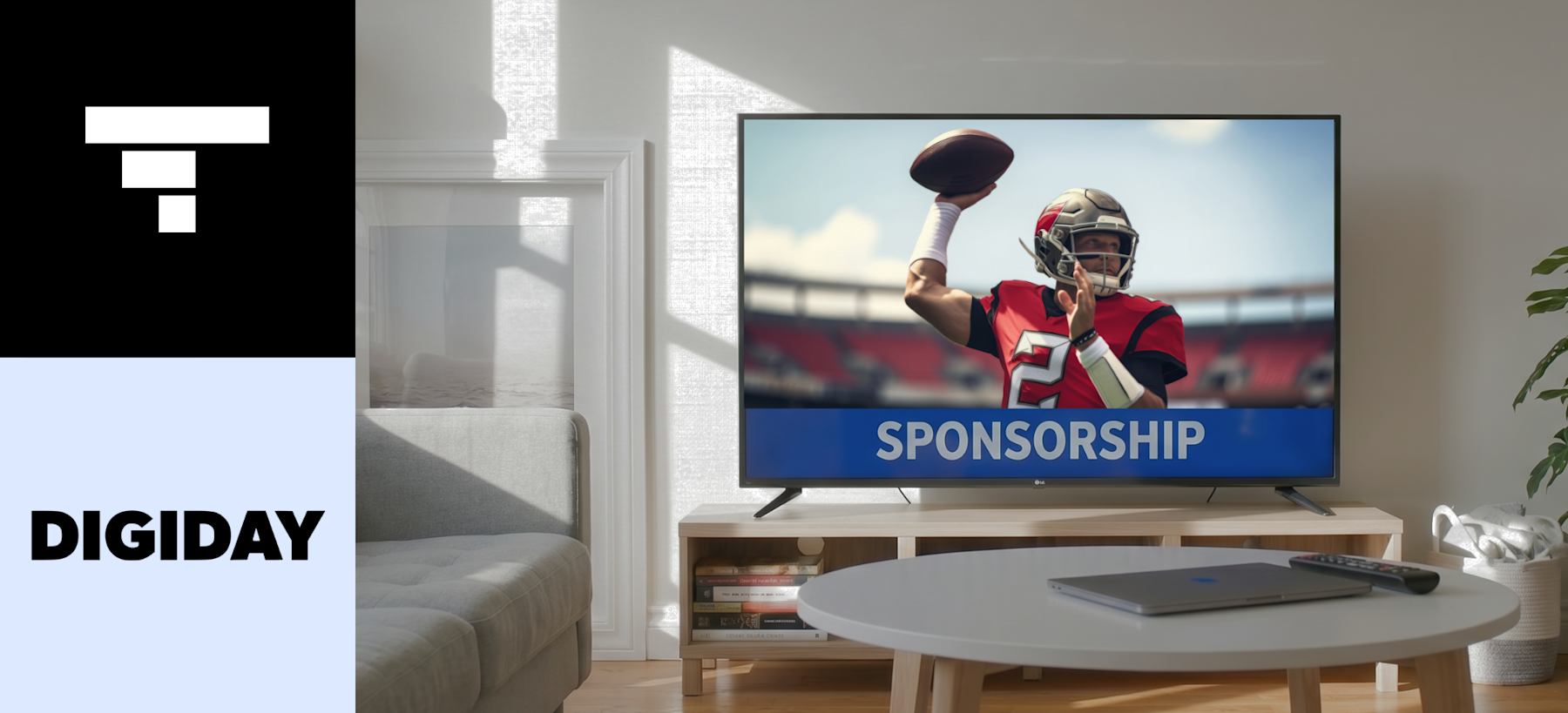
Streaming Sponsorships Drive Higher Response Than Standard CTV
A version of this article was originally featured in Digiday.
This guide is for performance and brand marketers allocating spend across connected TV (CTV) and streaming. It covers what streaming sponsorships are, how they compare to standard streaming buys, what the campaign data shows about their performance, and how to access this inventory. If you're trying to decide whether a sponsorship belongs on your media plan, this is where to start.
Key Takeaways
Streaming sponsorships carry 2–3× higher CPMs than standard placements — but CPM is the wrong metric to judge them on.
Sponsorship inventory delivers 62% higher response rates than non-sponsorship streaming inventory from the same clients.
Roughly 75% of in-show sponsorship audiences are incremental to what the rest of the plan already reaches.
In-show placements are only available via direct publisher relationships — DSPs and programmatic pipes can't get you there.
Conversion lifts hold across verticals: men's health (+51%), supplements (+48%), pharma (+16%), and more.
What Is a Streaming Sponsorship?
A streaming sponsorship is a guaranteed, title-specific media placement inside a particular show on a streaming platform. Unlike standard CTV buys, which serve ads across broad inventory, a sponsorship locks a brand to a specific title during the peak of viewer engagement.
Sponsorships include branded integrations not available in the programmatic marketplace: billboards ('Brought to you by…'), tagged tune-ins, lower thirds, co-branded slates, and in some cases page takeovers and social extensions. Publishers including Disney, Peacock, Paramount+, Netflix, and HBO Max each offer their own sponsorship structures, ranging from turnkey packages to fully custom integrations.
In short: A streaming sponsorship is the only way to guarantee ad placement inside a specific title on a streaming platform, with branded elements that standard media buys don’t include.
How a Standard Sponsorship Package Is Structured
Most streaming sponsorships bundle two components:
In-show media — guaranteed impressions running pre-roll and mid-roll inside the sponsored title.
Rotational ROS media — impressions running across the broader publisher inventory at lower CPMs.
The ROS component is what keeps the overall package economics reasonable: you’re not paying sponsorship CPMs on every impression in the deal. The real commitment is that sponsorships are non-cancellable once ordered, which means internal alignment needs to happen before the IO is signed.
Streaming Sponsorship vs. Standard CTV Buy: Key Differences
Use this comparison to evaluate which placement type fits a given campaign goal.
Factor | Streaming Sponsorship | Standard CTV Buy |
CPM | 2–3× higher than standard | Lower; varies by targeting |
Inventory access | Direct publisher only; not available programmatically | DSP or direct; widely accessible |
Placement guarantee | Guaranteed inside a specific title | No title-level guarantee |
Branded elements | Billboards, tune-ins, lower thirds, co-branded slates | Standard :15 or :30 spots only |
Audience incrementality | ~75% incremental to rest of plan | High overlap with existing reach |
Cancellability | Non-cancellable once ordered | Typically cancellable with notice |
Best for | Brands seeking high-engagement reach + conversion lift | Brands optimizing for CPM efficiency and scale |
The Data: Why Sponsorships Outperform on the Metrics That Matter
CPM is the wrong unit to evaluate streaming sponsorships. When you look at what actually happens in campaigns, the picture is different. Across Tatari’s campaign data, sponsorship inventory consistently outperforms standard streaming placements from the same clients on response rate, conversion rate, and cost per acquisition (CPA).
Did You Know?
62% higher response rate from sponsorship inventory vs. non-sponsorship streaming inventory across Tatari client campaigns.
Conversion Lift by Vertical
Vertical | Conversion Lift vs. Standard Streaming | Notes |
Men’s health | +51% | Highest lift observed |
Men’s grooming | +48% | — |
Supplements | +48% | — |
Pharma | +16% | Significant for a highly regulated category |
Feminine care | +11% | Demonstrates reach beyond obvious demos |
Real Campaign Example
A leading health and wellness brand ran 30 mid-roll sponsorships across five streaming publishers over 18 months. Results: despite in-show CPMs running nearly 2× their ROS inventory rate, the CPA for in-show placements came in within striking distance of standard buys while delivering a 53% higher response rate. The most expensive placement in the plan was its best performer.
Why Sponsorships Don’t Cannibalize Your Existing Plan
Approximately 75% of the audience reached through in-show sponsorship media is incremental to anything else the client had running in streaming. Sponsorships don’t eat into existing reach — they extend it to audiences the rest of the plan couldn’t get to.
The audience has moved to streaming. Shows like White Lotus, Squid Game, and House of the Dragon now see an average of 67% of their total viewership coming from the streaming version. Live events — Sunday Night Football, NBA, MLB — are streamed at scale. Even traditional broadcast titles like ABC’s Shifting Gears are available next-day on streaming. Sponsorships are the mechanism that reaches those viewers.
Why Your DSP Can’t Access This Inventory
Premium streaming sponsorship inventory is sold direct. Publishers decide what enters the programmatic marketplace, and in-show sponsorship placements largely don’t. Roughly 90% of CTV impressions come from just ten publishers. The supply is concentrated enough that direct publisher relationships are the only real path to sponsorship inventory.
This is not an argument against programmatic! It has a legitimate role in a complete TV strategy. But brands whose infrastructure doesn’t support direct buying are leaving the highest-performing segment of streaming off the table.
How to Evaluate a Streaming Sponsorship Opportunity
Before committing, work through these criteria:
Title alignment: Does the show’s audience match your target customer? Contextual relevance drives the conversion lift.
Audience incrementality: Will this title reach viewers if your standard CTV plan is missing? Ask the publisher for overlap estimates.
Package composition: What is the in-show vs. ROS impression split? Understand what CPMs apply to each component.
Flexibility: Branded elements, timing, and inventory splits are negotiable even when the initial proposal doesn’t suggest it.
Internal alignment: Sponsorships are non-cancellable. Confirm budget approval and creative readiness before signing an IO.
Measurement plan: Define how you’ll measure response rate, conversion rate, and CPA for in-show placements separately from ROS.
The Opportunity Heading Into the Back Half of 2026
Premium streaming content is not slowing down. The slate heading into the back half of 2026 — House of the Dragon, The Traitors, Landman, expanded NFL-streaming exclusives — represents exactly the kind of high-engagement programming that sponsorships are built around.
The brands winning in streaming right now aren’t necessarily the ones with the biggest budgets. They’re the ones who figured out that programmatic only gets you so far, and that the most engaged TV audiences, strongest response rates, and biggest conversion lifts are on the other side of a direct publisher relationship.
Ready to evaluate streaming sponsorships for your next campaign? Tatari’s team works directly with publishers to identify and execute sponsorship opportunities across the major streaming platforms. Let’s talk!
Frequently Asked Questions
Q: What is a streaming sponsorship?
A: A streaming sponsorship is a guaranteed, title-specific media placement inside a particular show on a streaming platform. It includes branded integrations (billboards, lower thirds, co-branded slates) not available through programmatic channels.
Q: How much do streaming sponsorships cost compared to standard CTV?
A: In-show sponsorship CPMs typically run 2–3× higher than standard streaming placements. However, the package usually includes a rotational ROS component at lower CPMs, which brings the blended package rate closer to standard buy levels.
Q: Are streaming sponsorships only for big brands with large budgets?
A: No. The brands seeing the strongest performance in Tatari’s data are performance-driven marketers across a range of budget sizes. What they have in common is direct publisher access and a measurement framework to evaluate in-show placements separately from ROS.
Q: Can I buy streaming sponsorships through a DSP?
A: In most cases, no. In-show sponsorship inventory is sold direct by publishers and is largely absent from the programmatic marketplace. Brands relying entirely on DSPs will not have access to this inventory.
Q: How do I measure the performance of a streaming sponsorship?
A: Measure in-show placements separately from the ROS component of the package. Track response rate, conversion rate, and CPA specifically for in-show impressions. Tatari’s attribution methodology isolates in-show performance to give an accurate read on the premium placement’s incremental contribution.
Q: Are streaming sponsorships cancellable?
A: No. Once an IO is signed, sponsorships are non-cancellable. Budget approval and creative readiness need to be confirmed before committing.
Q: Which publishers offer streaming sponsorships?
A: Disney, Peacock, Paramount+, Netflix, and HBO Max all offer sponsorship structures, ranging from turnkey packages to fully custom integrations. Package specifics, branded elements, and pricing vary by publisher and title.
Q: What audience incrementality can I expect from a streaming sponsorship?
A: Based on Tatari campaign data, approximately 75% of the audience reached through in-show sponsorship media is incremental to what a client already reaches through other streaming inventory. Sponsorships extend reach rather than overlapping with it.

Sam Joachim
I lead client services at Tatari. Outside of work, I have a passion for entertainment, music, and creative pursuits — having supported world-renowned recording artists and produced TV ads that aired during the Super Bowl.
Related
PATTERN Beauty Proves the Beauty of TV for Brand Awareness
PATTERN Beauty proved TV can do more than build awareness—it can drive real growth. See how a strategic mix of CTV and linear TV delivered major lifts in traffic, revenue, and brand consideration.
Read more
Avocado Mattress Proves Interactive CTV Ads are Ripe for Growth
Avocado Mattress cracked the code on streaming by turning passive viewers into active shoppers through interactive CTV ads that helped drive retail foot traffic. Explore how these emerging ad formats are finally transforming the big screen into a powerful, actionable storefront.
Read more
Why TV Syndication Is the Best-Kept Secret in Modern Advertising
TV syndication quietly delivers millions of loyal, highly attentive viewers every day—often outperforming both pricey primetime and cheap direct response buys. So why are most advertisers ignoring one of the most efficient, brand-safe, and scalable opportunities on television?
Read more